


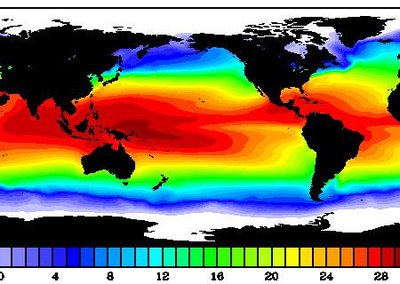
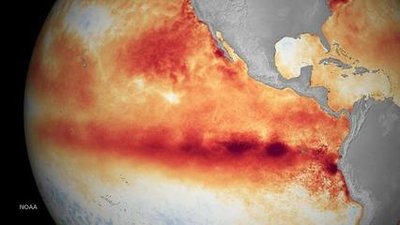
On June 11th this year, the Climate Prediction Center of the National Oceanic and Atmospheric Administration (NOAA) of the United States officially issued an El Niño warning – the official wording was “El Niño has arrived”. This is not an ordinary annual climate report. The probability assessment released at the same time indicated that the probability of this event evolving into the “extremely strong” level between November 2026 and January 2027 is as high as 63%, and its intensity will “rank among the top in the history with instrument records since 1950″. The median of the ensemble forecast of the European Centre for Medium-Range Weather Forecasts (ECMWF) is even more aggressive: it is expected that the sea surface temperature anomaly in the Niño 3.4 region will reach +3℃ in December this year, and some scenarios even exceed +4℃.
To understand the significance of this figure: The strongest El Niño event since modern meteorological records began occurred in 2015-16, with a peak anomaly of +2.6℃. If the above forecast comes true, the event in 2026-27 will exceed it by at least 15%, entering an unprecedented range.
What do historical archives tell us?
El Niño is not a new phenomenon, but each time an event of “super strength” occurs, it leaves scars in the history of agriculture.
1997-98: The peak Niño 3.4 index for this event was approximately +2.3℃, making it one of the strongest in the 20th century. Indonesia, the Philippines, and Thailand suffered from severe droughts. The Food and Agriculture Organization of the United Nations (FAO) reported that the crop yields in Central America and the Caribbean region decreased by about 15% to 20% compared to the previous year. Some countries suffered even more severe losses. The wheat planting areas in Brazil and Argentina significantly decreased due to abnormal rainfall. In Southeast Asia, this event directly led to the loss of approximately 15 million tons of rice.
2015-16: Both reached a peak of +2.6℃, which was the highest in modern records. The corn production in India declined by approximately 4%, and the rice production dropped by about 1%. The Southeast Asian market was affected, and the price of rice rose accordingly, forcing India to repeatedly tighten export restrictions. Southern Africa suffered from a severe drought, and the hydropower output of the Kariba Dam in Zambia and Zimbabwe dropped sharply, leading to a secondary energy crisis spreading across multiple countries.
In 2023-24: The World Meteorological Organization (WMO) listed this event as one of the five strongest on record. This event, in conjunction with the ongoing global warming, pushed 2024 to become the hottest year on record and directly exacerbated agricultural droughts in parts of East Africa and South Asia.
A large-scale assessment study published in Nature Communications in 2014 showed that El Niño events typically cause the combined performance of global corn, rice, and wheat yields to deviate from the normal range by -4.3% to +0.8%, while soybeans benefited by approximately 2.1% to 5.4% due to improved precipitation in some parts of the Americas. Behind these data lies a significant regional disparity – the outcome does not depend on the intensity of the event, but rather on where and what you grow.
Projection of regional differentiation in 2026
The laws of history have provided us with an imperfect but useful map of risks.
India and South Asia: India accounts for approximately 24% of the world’s rice production. The Indian monsoon has a nearly textbook-like negative correlation with ENSO (El Niño-Southern Oscillation) – during El Niño years, the summer monsoon is generally weaker. The three major strong events in 1997-98, 2015-16, and 2023-24 each triggered export restrictions in New Delhi, transmitting the pressure to global rice-importing countries. The FAO’s current warning report clearly states that the risk of agricultural drought in South Asia and Southeast Asia is “the most acute”, with a probability of over 50% in some areas facing drought.
Southeast Asia: Indonesia, the Philippines, Thailand, Vietnam, and Cambodia are all within the historically high-risk zone. Palm oil is particularly sensitive – Malaysia and Indonesia are the absolute major producers of palm oil globally, and both countries have not escaped any of the severe El Niño events in the past. Cotton and sugar are also in the high-risk category.
Australia: Australia is regarded as the wheat-producing country most sensitive to ENSO signals globally. During El Niño years, precipitation in Queensland and New South Wales often shows significant deviations from normal levels, posing a direct threat to spring wheat and barley.
Brazil: The situation is the most complex. El Niño usually brings more precipitation to the southern part of Brazil, which is beneficial for soybean growth. However, excessive rainfall can also lead to a decline in coffee quality and an increase in diseases of some leguminous crops. The JRC report of the European Union indicates that the global price of hard wheat is expected to rise significantly in the scenario of enhanced El Niño intensity, while the global prices of soybeans and hard red winter wheat may fall due to the benefits from the American production areas.
East Africa and the Sahel: This region follows a logic opposite to that of Southeast Asia – during El Niño years, precipitation increases, but in the context of soil degradation and weak infrastructure, heavy rain may not lead to a harvest but instead bring floods and soil erosion. The FAO has issued a warning for Somalia, and the JRC’s INFORM Warning tool has classified several Central African countries as being at a “high humanitarian risk” level.
China: Historically, the impact of El Niño on China varies by region. The south of China experienced excessive rainfall, while the north and northeast faced an increased risk of drought. During the 1997-98 period, there was a major flood in southern China and severe drought in the northeast, which affected the harvest that year.
The transmission logic of the agricultural chemicals market
The relationship between climate events and the pesticide market is not a simple positive correlation and needs to be discussed categorically.
The risk of demand-side contraction: During drought years, farmers’ willingness to plant and the intensity of their investment decrease, and the purchase of pesticides is often one of the expenses that are most susceptible to being cut. During the El Niño event in Southeast Asia in 1997-98, the demand for pesticides in Indonesia and the Philippines significantly declined. This was partly due to the contraction in crop area and partly because farmers reduced their investment after their income decreased.
Structural changes in pests and diseases: Extreme precipitation in certain areas leads to a high incidence of diseases, while drought may bring the invasion or outbreak of specific pests. Historically, there has been a certain correlation between El Niño years and the activities of migratory pests such as locusts. In 2023-24, the combination of high temperatures and El Niño caused abnormal activity of pests such as whiteflies and mites in multiple tropical markets.
Channel inventory and capital pressure: In years with extreme agricultural climate conditions, the inventory clearance in distribution channels often lags by one to two quarters. In the Brazilian market during the 2023-24 inventory reduction period, the combined effect of El Niño brought about local extreme rainfall, and soybean diseases (such as Asian soybean rust) in some areas actually worsened due to the high humidity environment. This regional differentiation for Chinese agrochemical exporters means that within the same year, the demand signals from different markets may be completely opposite.
The combined pressure from fertilizers and pesticides: It is worth noting that the arrival of El Niño in 2026, combined with the tightened logistics in the Strait of Hormuz due to the situation in the Middle East, has already put pressure on the exports of urea and phosphate fertilizers. In his report in March this year, Paul Donovan, the chief economist of UBS, clearly stated: “The shortage of nitrogen fertilizers may not be the biggest threat to agricultural prices this year; the super El Niño is.”
The reliability of climate models has declined.
In extreme scenarios, the reliability of climate models will decline. The JRC report clearly states that if the event reaches “unprecedented” intensity, its model has gone beyond extrapolating from historical precedents. An anomaly of +4°C in Niño 3.4 has never occurred in the era of instrumental records. A similar event in 1877-78 caused a global famine, but we do not have modern precision data to make a strict analogy.
Therefore, the position of this article is: Plan risks based on the “strong to extremely strong” events within the current 70% probability range as the baseline scenario, rather than betting on the tail scenario of +4°C. The former is already sufficiently severe and has ample historical precedents to rely on.
Another source of uncertainty lies in the response capacity of China’s agriculture. In recent years, China has significantly increased its investment in agricultural meteorological warnings and irrigation infrastructure. Its drought-resistance capability is incomparable to that in 1997-98. The situation in India is similar – the irrigation system after the Green Revolution covers a considerable portion of the rice-growing areas, enhancing its resilience to abnormal monsoon conditions. However, historical data provides a clearer indication of the risk direction.
The 2026 El Niño event is likely already underway. The real question is its intensity peak, and whether the combined effect of the atmosphere and the ocean will drive it to even surpass historical records.
For global agriculture, this means that a structural uncertainty window will remain open from the second half of this year until the spring of 2027. For the agrochemical industry, this is both a signal of regional differentiation in demand and a stress test for the stability of the supply chain.
History tells us that the agricultural impact of a super El Niño event typically has a lag period of 6 to 12 months – the true yield losses often only become apparent after the peak of the event. This means that the prices currently seen in the market may not have fully priced in this risk.
Post time: Jun-23-2026
