



Dinotefuran has a wide range of insecticidal activity and no cross-resistance with commonly used pesticides. It has a good systemic translocation effect, and its active ingredients can be well transported to every part of the plant tissue. Especially for the control of aphids, stink bugs, rice planthoppers, thrips and other sucking pests, its efficacy is more prominent. Moreover, it can also achieve a relatively good inhibitory effect on the sucking of pests.
Dinotefuran can kill many pests on crops such as whiteflies, planthoppers, aphids, thrips and leafhoppers. It has a good effect on pests such as black-tailed leafhoppers of the order Diptera, sharpshooter scale insects, scale insects, small cabbage moths, yellow thrips, white-backed planthoppers, star bugs, rice stem borers and yellow striped flea beetles.
The application scope of Dinotefuran
Dinotefuran is toxic to animals such as silkworms, bees, shrimps, crabs, etc. Therefore, it is prohibited to use it in silkworm houses, near mulberry plantations, and in rice fields where shrimps and crabs are raised together. Additionally, Dinotefuran is prone to causing groundwater pollution, so it should be used with caution in areas with good soil permeability or shallow groundwater levels.
The effects and functions of Dinotefuran
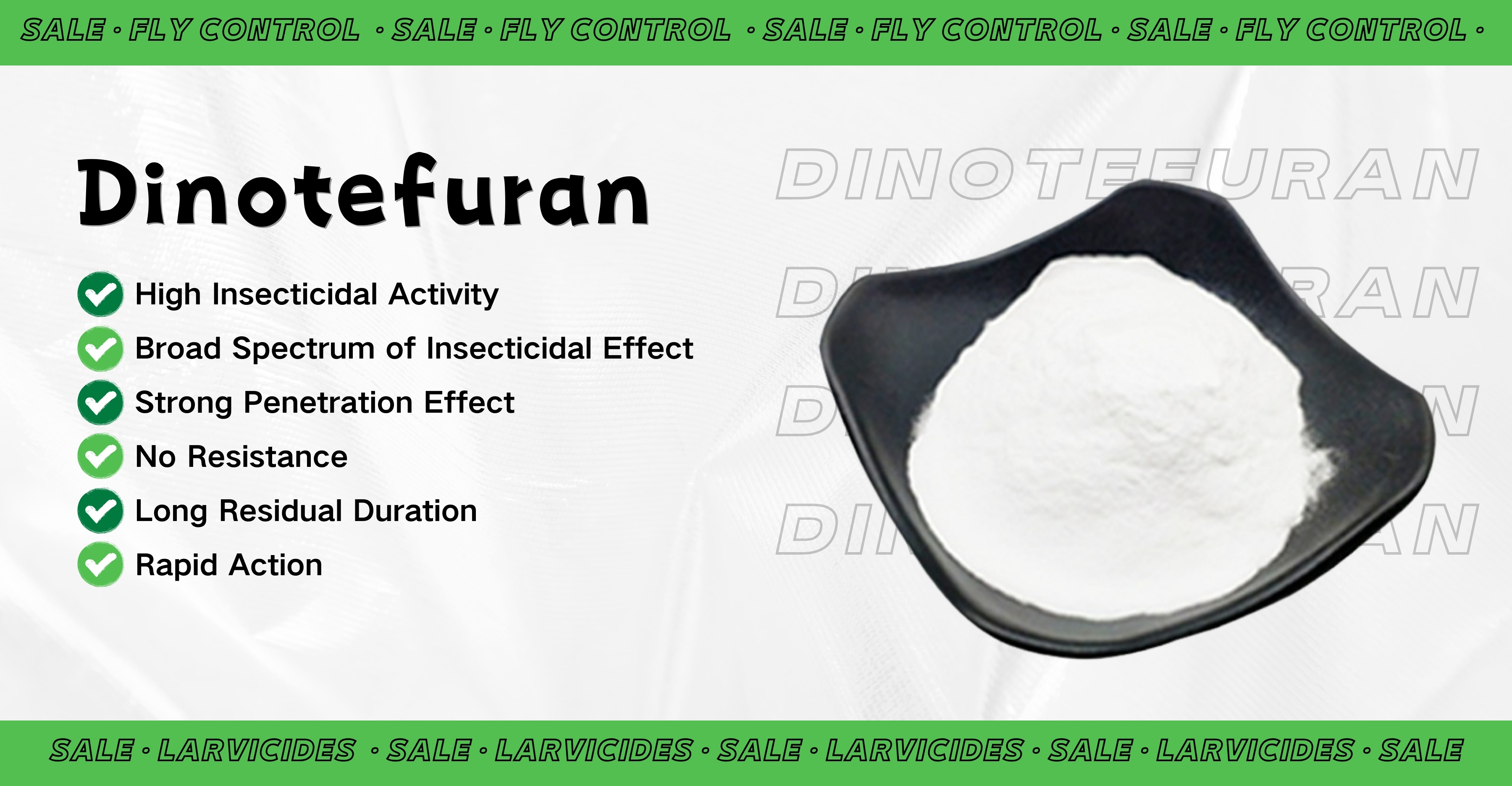
Dinotefuran belongs to the nicotine-based insecticides. It acts on the nervous system of pests, causing them to become overly excited and eventually die from paralysis. Dinotefuran not only has stomachic and contactic effects, but also possesses the following six characteristics:
1. Wide spectrum of insecticidal action
Dinotefuran has a wide range of insecticidal effects on pests such as hemipterans, lepidopterans, and dipters on crops like wheat, rice, cotton, vegetables, fruit trees, and flowers.
2. Excellent efficacy against piercing-sucking mouthpart pests
Dinotefuran not only shows high insecticidal activity at very low doses, but also has excellent efficacy against piercing-sucking pests, mainly used for controlling aphids, leafhoppers, whiteflies, and mealybugs.
3. No resistance
Dinotefuran belongs to the third-generation new nicotine-based insecticides. It has no cross-resistance with other agents, and its efficacy is better when used against pests that have developed resistance to nicotine-based pesticides.
4. Long residual duration
The residual duration of Dinotefuran can reach 4-8 weeks (theoretically, it can last for 43 days). This allows for a lower possibility of pest recurrence.
5. High activity (strong penetration)
Dinotefuran has a high penetration effect and can effectively transfer from the leaf surface to the inside of the leaf. Even in dry soil (with soil moisture up to 5%), it can still exert a stable effect.
6.After being applied, Dinotefuran can be quickly absorbed by the crops and widely distributed throughout the crops’ flowers, leaves, fruits, stems, roots, etc. If the pesticide is sprayed on both the front and back sides of the leaves, it can to some extent truly achieve the effect of attacking from the top and killing from the bottom, and attacking from the bottom and killing from the top.
Post time: Mar-17-2026