



I. Main Properties of Chlorantraniliprole
This pesticide is a nicotinic receptor activator (for muscles). It activates the nicotinic receptors of pests, causing the receptor channels to remain open abnormally for a long time, resulting in the unrestricted release of calcium ions stored within the cells. The calcium pool is depleted, causing muscle regulation to weaken, paralysis, and ultimately death.
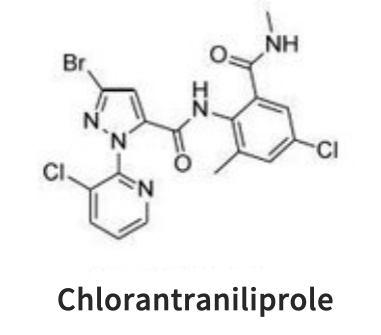
1. The mode of action of this pesticide is mainly stomachic, with certain contact killing effects, but it is not the main killing method. It has no fumigating effect.
2. This pesticide is an internal translocator insecticide. It has strong penetration. The pesticide can be absorbed and transported by plants to all parts of the plant body. Pests die after eating the toxic leaves, stems, and flowers. The pesticide also has strong permeability and can penetrate the epidermal cell layer of the stem and enter the xylem, thereby conducting to other un-treated areas that have not been sprayed.
3. This pesticide has high activity against larvae and poor efficacy against adult pests of large size. It is basically ineffective against eggs. However, it has strong lethality against newly hatched larvae. Larvae that bite through the eggshell and come into contact with the pesticide on the incubation surface will be poisoned and die. Therefore, it is advisable to use it during the larval stage of low age, preferably during the egg hatching peak period, especially in areas where resistance has developed.
4. After being ingested, insects immediately stop feeding and no longer cause harm. However, its rapidity of action is poor. The death process of pests after ingestion is as follows: rapid cessation of feeding (approximately 7 minutes) → loss of vitality → regurgitation → muscle paralysis → significant inhibition of production → death within 24 to 72 hours.
5. This pesticide decomposes relatively slowly in plants and has the characteristic of a long duration of efficacy. Generally, it can maintain the control effect for more than 14 days.
6. This pesticide has adhesion to the soil and poor fluidity. The half-life of degradation is less than 2 to 12 months.
7. This pesticide has high insecticidal activity, a wide spectrum of activity, and is applicable to a variety of crops. It mainly controls lepidopteran pests and can disrupt the mating process of certain lepidopteran insects, reducing the egg-laying rate of various noctuid pests. It has good control effects on scarabaeid, leaf beetle, aphid, and fly pests of the hemipteran, dipteran, and dipteran families, respectively. However, its activity is significantly lower than that against lepidopteran pests and should be selected based on the price-performance ratio.
8. This pesticide is relatively safe for mammals and vertebrates. There is only one type of nicotinic receptor in insects, while there are three types of nicotinic receptors in mammals, and the nicotinic receptor of insects is less similar to that of mammals. The activity of this pesticide against insect nicotinic receptors is 300 times that of mammals, showing high selectivity and low toxicity to mammals. The toxicity level registered in China is slightly toxic, and it is safe for applicators.
9. This pesticide has low toxicity to birds, fish, shrimp, and other vertebrates, and is relatively safe for beneficial organisms such as parasitic and predatory natural enemies in the environment. However, it is highly toxic to silkworms.
10. This pesticide is highly compatible. It can be mixed with insecticides with different modes of action such as methamidophos, abamectin, cyfluthrin, cypermethrin, chlorfenapyr, and neem oil to be used in combination, which can expand the control range, delay the development of resistance, improve the speed of action, extend the duration of efficacy, or reduce the cost of application.
II. Main Application Techniques of Chlorantraniliprole
1. Application period: Use it when the pests are at a young stage. It is best to apply it during the peak period of egg hatching.
2. Use it strictly in accordance with the instructions on the label. For spray application, misting or fine spraying is more effective.
3. Determine the maximum number of applications per season and the safety interval based on the crop registered for the product.
4. When the temperature is high and the evaporation in the field is significant, choose to apply the pesticide before 10 a.m. and after 4 p.m. This can not only reduce the amount of pesticide solution used, but also better increase the amount of pesticide solution absorbed by the crops and their permeability, which is conducive to improving the control effect.
III. Precautions for the Use of Chlorantraniliprole
While adhering to the general precautions for pesticide use, the following points should be noted when using this product:
1. This pesticide is sensitive to tomatoes, eggplants, etc., and may cause spots, wilting, etc.; citrus, pear, mulberry trees and other fruit trees are sensitive during the new leaf stage and leaf expansion stage, which may cause leaves to turn yellow, resulting in smaller fruits, affecting fruit yield and quality.
2. Do not apply the pesticide on windy days or when it is expected to rain within 1 hour. However, this pesticide is resistant to rain erosion, and if it rains 2 hours after spraying, there is no need for additional re-spraying.
3. This product is classified as Group 28 of the International Insecticide Resistance Management Committee and is a type of insecticide. To better avoid the emergence of resistance, the use of this product for a single crop should not exceed 2 times. In the current generation of target pests, if this product is used and can be continuously used for 2 times, it is recommended to alternate with compounds with different action mechanisms (other than Group 28) in the next generation.
4. This product is prone to dissociation in alkaline conditions and cannot be mixed with strong acids or strongly alkaline substances.
5. It is highly toxic to algae and silkworms, etc. It is prohibited to use in silkworm houses and mulberry orchards. When using it, it is necessary to maintain a certain isolation zone from silkworms to avoid spreading to mulberry leaves. It is also prohibited to use in the flowering period of nectar-producing crops and the release areas of parasitic wasps and other natural enemies.
Post time: Jan-15-2026